个人手记 · 学习与生活
到了四十岁,
还值得学什么?
把已有经验接上新工具,用有限的时间做一次有结果的尝试。聊聊就业、经营和生活里的学习,也把时间、家庭责任和真实反馈算进去。
看完,聊两句学习的账,也包括生活
到了四十岁,学习的账会多几项:房贷和孩子,父母的需要,自己的精力,还有工作结束后真正能留下的时间。选一门课,往往也在选择接下来几个月怎样生活。
学习仍然值得。更值得认真选择的,是能增加自己选择余地的能力:让熟悉的工作做得更好,让经验可以带到别处,也让日常生活有一点新的空间。先从自己已经懂的事情向前走一步,再决定是否需要更大的转身。
研究证据:年龄之外,还有学习的条件
OECD对成人技能调查的分析发现,培训参与和在工作中学习会随年龄、教育程度和工作条件而变化。参与率较低,不能直接解释成某个人“学不动”;这些年龄组差异也不能证明所有人在四十岁出现同一道能力分界。[1]
2026年《教育概览》还讨论了时间限制、雇主支持和健康状况等学习条件。ILO的终身学习报告则强调,技术能力需要与基础能力、沟通和判断等结合,培训效果也取决于岗位需求与支持体系。[2][3]
中国也有值得留意的变化。世界银行在2026年7月中国经济简报中指出,低碳转型带来的需求,既涉及专门技术,也涉及系统思考、适应学习和数字能力等可迁移技能。它说明值得关注技能组合,不能据此认定某门培训或某张证书一定增加收入。[4]
这些资料提供方向,不替个人开课程清单。OECD数据不等于中国中年人群的统计;国际培训研究涉及不同国家与项目,结果不能直接搬到中国某个城市、行业和家庭。
先决定,学来做什么
如果为了就业,值得核对的是目标岗位需要什么、自己缺什么、能拿出什么证明。先看真实招聘、问同行和用人方,再选择训练;有明确门槛的岗位,要先核对准入要求与完整训练路径。
如果为了经营,验证对象是客户。对方愿意采用什么、为什么付费、怎样验收、多久回款,比“我已经会操作这个软件”更接近经营问题。提供服务,还要会报价、约定范围和核算成本。
如果为了生活,判断标准可以是使用、乐趣和相处的质量。学摄影、做饭、读历史,或者学会更清楚地表达自己的想法,都可以有价值。一个爱好可以保留为爱好,是否赚钱由自己的目标决定。
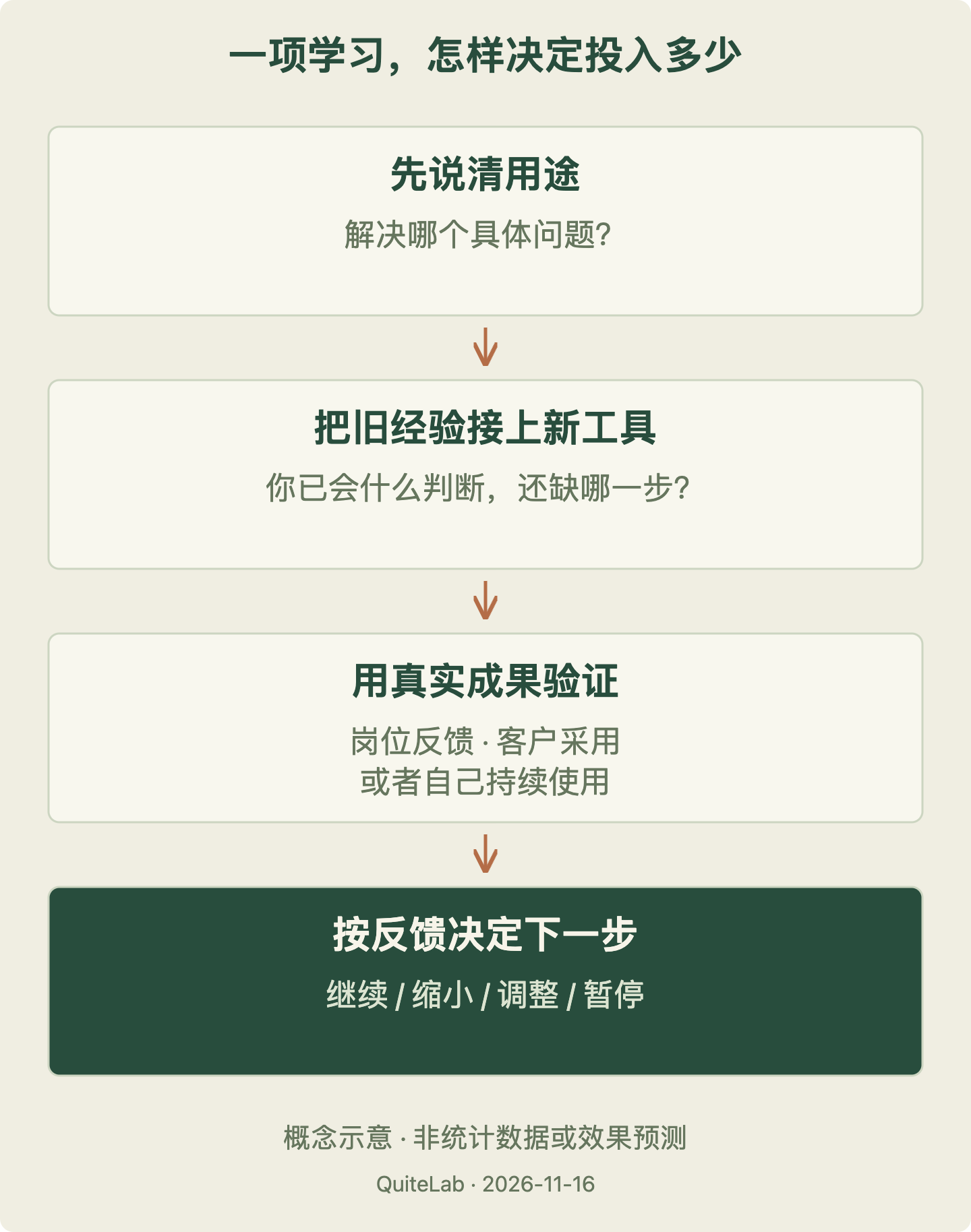
在一件具体的事上,把经验接起来
不少人到这个阶段,已经积累了行业判断:哪些客户的要求不清楚,哪些采购条件容易出问题,哪些环节经常返工。这些经验可以成为新学习的起点,但也需要拿到今天的需求里重新检验。
例如,有采购经验的人,可以从一份供应商比价和交付跟踪表练习数据工具;熟悉售后的人,可以试着整理一套常见问题与处理流程。这里是练习设计,不是成功案例。先记录旧做法的时间、错误和返工,再用新方法完成同类任务,比较结果。
AI也可以放在这种具体任务里:整理材料、起草表达、协助检查,再由自己核对事实、规则和交付结果。值得学的是如何定义问题、提供条件、判断输出与承担责任。只会反复生成内容,尚不足以形成可交付的能力。
也要留一点可迁移的底子:读懂要求、用表格看清数字、把复杂事情写明白、与人协商范围。它们可以随着具体任务一起练,不必等到“基础都学完”才开始做事。
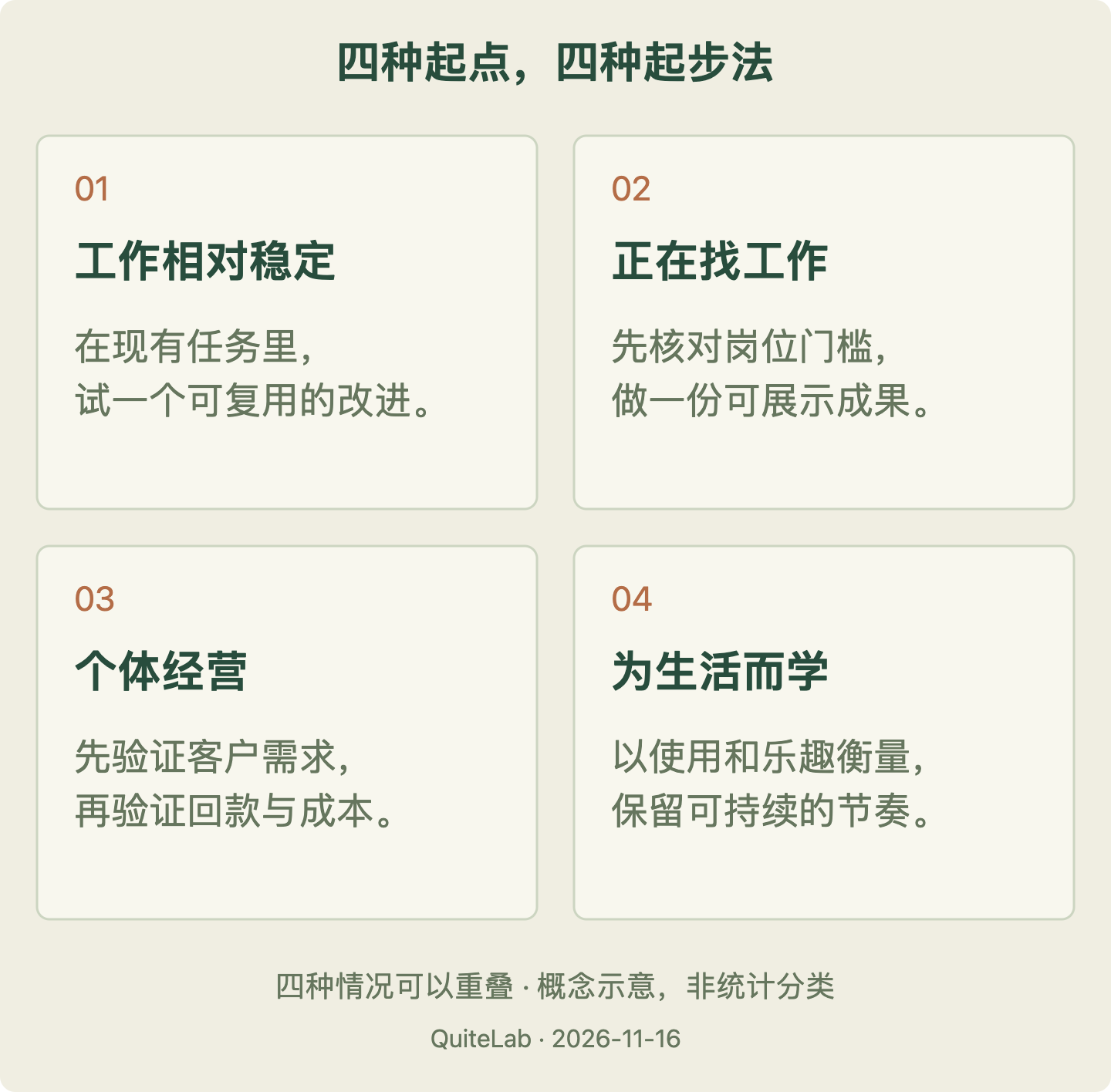
三个真实的人,三种学习的理由
以下案例依据公开报道整理,年龄按报道时点标注。它们展示不同学习路径,不是成功率统计,也不保证同样培训会有同样结果。
陈波:先看到岗位,再补对应能力
2026年4月《经济日报》报道时,陈波43岁,此前是宜昌一家锂电材料企业的操作工。他先看到企业招聘,再到宜都市就业训练中心学焊接,通过考核取得特种作业操作证,随后应聘为机械维修工。报道提到工资增加,但没有披露幅度。值得借鉴的,是先核对岗位需求,再补上对应技能。[5]
这是一次有具体招聘需求的转岗,不是“学焊接就一定涨薪”的证明。培训费用、用时及后续长期结果未披露。
畅婷婷:重返职场,也需要岗位与支持
2026年3月央视报道时,畅婷婷42岁,已经取得照护技能证书,从事居家养老照护。宁夏日报的后续报道补充,她此前长期照顾孩子,因符合帮扶条件获得免费培训,又经公益爱心岗位推荐进入养老服务。这个例子里,技能之外还有培训资助和岗位对接;选择学习路径时,应把这些支持条件一起查清。[6][7]
可借鉴的不只是选了什么技能,还有如何获得培训资助和岗位对接。免费培训与推荐均有当地政策条件,不能假定每个人都能获得同样支持。
邱再蓬:为生活,先做一件喜欢的作品
2024年7月中国青年报采访中,45岁的小学教师邱再蓬在南宁参加剪纸体验课,一个半小时后完成了自己设计的纸蝴蝶并装裱。她看重的是工作之外的休闲空间。这不是转行或增收的故事,却说明学习也可以为了兴趣和生活:先完成一件自己愿意继续做的小作品,再决定投入多少时间。[8]
一次体验课的成果,不等于掌握一门职业;原报道未说明她靠剪纸获得收入,本文也不作这种推断。
学费之外,把时间也算进去
报名前算一次完整成本:课程、软件、设备、交通和考试,加上练习时间、可能少接的工作,以及需要别人分担的家务。课程结束到能独立交付之间,通常还要留下练习和反馈的空间,具体多久要看起点与任务。
先试一个可维持的节奏,例如每周三次、每次四十分钟,连续四周。这只是排期示例,可以按轮班、照护责任和身体情况调整。把时间写进日历,看看是否真的有地方容纳它,也和家人讲清楚这段安排。
工作稳定的人,可以先争取在现有任务中练习;正在找工作的人,先核对岗位与现金缓冲,避免把全部希望押在一张结业证;经营者先试小单;为生活而学的人,可以把持续使用和愿意再来一次当作反馈。
用九十天,验证一条小路径
下面是低成本试学的安排,不是保证完成转型的期限。目标是尽早拿到信息,决定下一笔时间和钱是否值得投入。
| 时间 | 先做什么 | 留下什么证据 |
|---|---|---|
| 第1—30天 | 只选一个用途,核对岗位、客户或个人需求。用免费资料或短期试学,完成一个小任务。 | 一份能展示的成果,以及实际花费的时间和钱。 |
| 第31—60天 | 让真实使用者反馈。就业方向问岗位匹配;经营方向验证采用与付费意愿;生活方向看自己是否持续使用。 | 具体修改意见、采用情况或小额试单结果,而非只有点赞。 |
| 第61—90天 | 重复完成一次,检查质量、成本与节奏。根据证据决定继续、调整用途、缩小投入或暂停。 | 第二次交付与第一次的差别,以及下一阶段的明确安排。 |
如果是职业方向,反馈还要问得具体:被认可的是技能,还是只有熟人情面?被拒绝的是作品质量、行业门槛,还是当地缺少岗位?一次没有结果不必急着归因;但连续没有真实采用,也应回头检查选择的需求。
证书有无价值,要看用人方是否识别、是否确为岗位要求,以及能否补上能力证明。课程里可以学到知识,市场验证仍要另做;能不能就业,也受岗位数量、招聘偏好和地区条件影响,不能把结果全算在个人努力上。
知道何时调整,也是一种能力
开始之前,为试学写下投入上限、复核日期和希望看到的结果。如果课程内容与目标任务无关、始终没有可检查的成果,先暂停加购;如果学习持续挤压睡眠、照护或基本生活,缩小范围或延后安排。
已经投入的学费,不是继续投入的充分理由。可以保留有用的部分,把方法带回原工作,也可以承认这项技能更适合做兴趣。一次试学的价值,还包括帮助自己及时排除一条成本过高的路。
四十岁仍然可以学得深、学得长。选择一条与现实生活接得上的路径,既认真练习,也认真看反馈,会更容易知道:下一步为什么值得继续。
你会把下一段时间,用在哪里?
- 过去学过的东西里,哪一项到今天仍然有用?它为什么留下来了?
- 现在最妨碍你学习的,是时间、钱、找不到方向,还是缺少练习与反馈的机会?
- 如果给自己九十天,你想尝试一项和工作有关的能力,还是一件纯粹喜欢的事?
分享经历和做法即可,不必公开收入、雇主、住址或联系方式。
资料与使用说明
资料核查截至2026年11月16日。研究资料用于说明成人学习的背景;选择流程、练习方法和九十天安排是本文的建议。两幅图均为原创概念示意,不是统计排名或培训收入预测。
OECD资料使用参与国家和经济体的成人技能调查等数据,不作为中国四十岁人群的统计。ILO讨论不同国家、年龄和项目的技能与学习体系。世界银行的相关分析以中国低碳转型为背景,不据此推断所有行业或某门课程的收益。
资料来源与阅读说明
文中区分研究证据、公开报道的人物经历和文章建议。两幅图为概念示意,不是统计结果;个案不能代表成功率,也不保证培训收益。
- OECD《Employment Outlook 2025》第4章:中老年劳动者的技能与工作 ↗2025-07-09
- OECD《Education at a Glance 2026》:成人教育与培训参与 ↗2026-09-29
- ILO《Lifelong Learning and Skills for the Future》 ↗2026-05-05
- 世界银行《中国经济简报:Rebalancing Growth》发布说明 ↗2026-07-07
- 经济日报:就业“长”在产业上(中国就业网转载) ↗2026-04-03
- 央视焦点访谈:技能充电,“职”引未来(红星新闻网全文转载) ↗2026-03-26
- 宁夏日报:托起“城市奔跑者”的就业底气 ↗2026-05-12
- 中国青年报:75.1%受访青年愿意参加夜校 ↗2024-07-26
把话题留给大家
过去学过的东西里,什么到今天仍然有用?如果给自己九十天,你想尝试哪项能力,或者哪件纯粹喜欢的事?欢迎聊具体经历,不必公开个人财务和联系方式。
PERSONAL NOTES · LEARNING & EVERYDAY LIFE
At Forty, What Is Still Worth Learning?
Connect experience with new tools, and use limited time for a practical experiment. A look at learning for work, business and everyday life, with time, family responsibilities and real feedback in the picture.
Join the conversationLearning has a place in the rest of life
By forty, the decision to learn may have more items in the ledger: a mortgage and children, parents who need help, your own energy, and the time actually left after work. Choosing a course often means choosing how the next few months of life will be spent.
Learning is still worthwhile. What deserves careful thought is which capabilities will give you more options: doing familiar work better, taking experience into another setting, or making room for something new in everyday life. Start a step beyond what you already know, then decide whether a bigger change is needed.
The evidence: conditions matter as well as age
The OECD’s analysis of adult skills surveys finds differences in training participation and learning at work by age, education and working conditions. Lower participation cannot simply be read as an individual being unable to learn. Nor do differences between age groups establish a common boundary in everyone’s ability at forty.[1]
Education at a Glance 2026 also examines conditions for learning, including time constraints, employer support and health. The ILO’s report on lifelong learning emphasises combinations of technical and foundational capabilities, communication and judgement. The value of training also depends on job requirements and the systems that support learning.[2][3]
There are changes worth watching in China too. In its July 2026 China Economic Update, the World Bank describes demand associated with the low-carbon transition for both technical skills and transferable capabilities such as systems thinking, adaptive learning and digital skills. This is a reason to examine combinations of skills, not a guarantee that a particular course or certificate will increase income.[4]
These studies offer context rather than a personal course list. OECD findings are not statistics for middle-aged people in China. International training research covers different countries and programmes, so its results cannot be transferred directly to a particular Chinese city, industry or household.
First decide what the learning is for
If the aim is employment, check what the target job requires, what you are missing and what evidence you can show. Look at real vacancies and speak with people in the field and employers before choosing training. Where an occupation has formal entry requirements, check those requirements and the full training path first.
If the aim is running a business, the test is with customers. What they will use, what they will pay for, how they will assess delivery and when they will pay are closer to the business problem than simply knowing how to operate software. Providing a service also requires pricing, agreement on scope and an understanding of costs.
If the aim is everyday life, the measures can be use, enjoyment and the quality of time with others. Photography, cooking, history, or learning to express yourself more clearly can all be valuable. A hobby can remain a hobby; whether it needs to earn money depends on your own purpose.
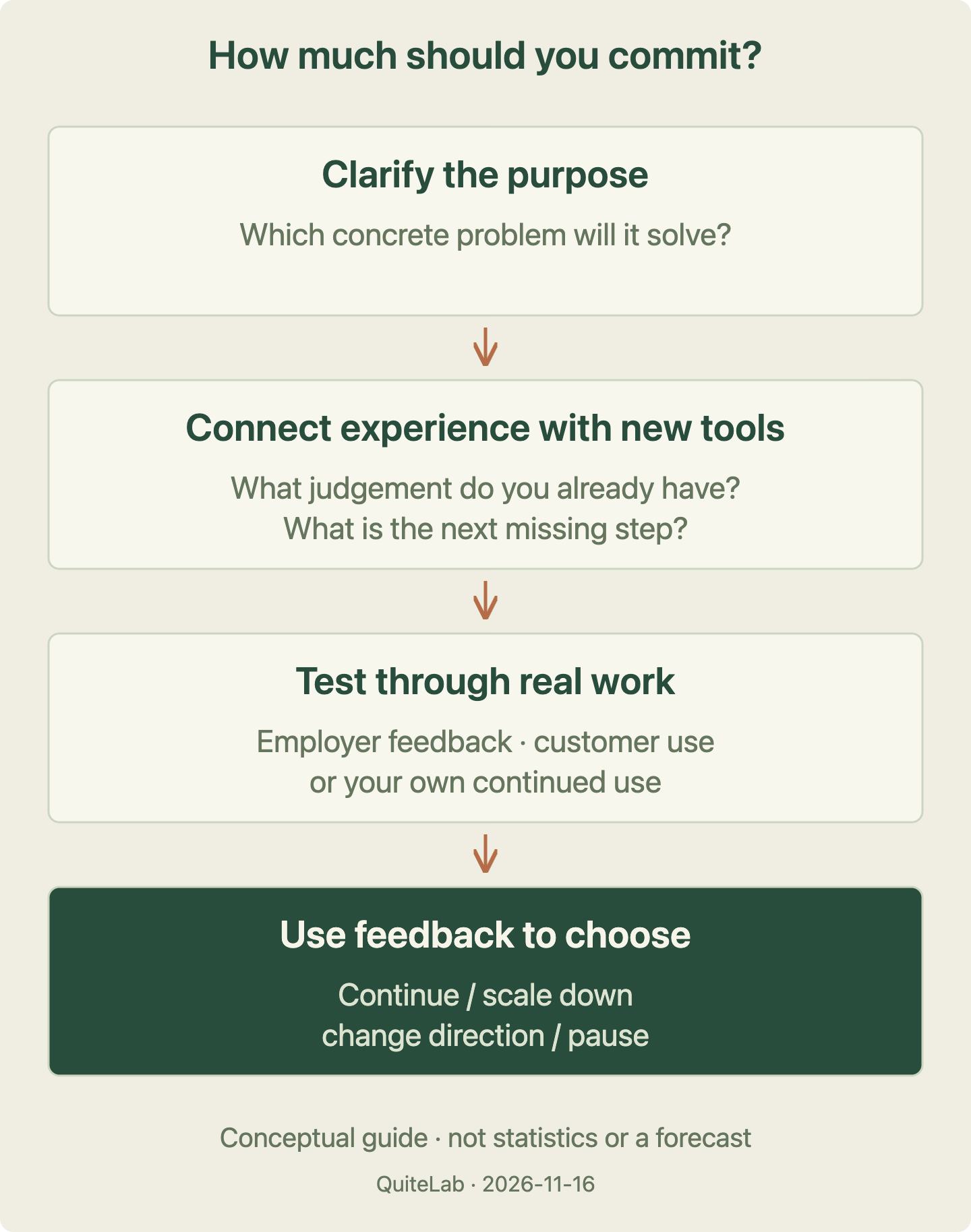
Connect experience through a concrete task
By this stage, many people have accumulated practical judgement: which customer requests are unclear, which purchasing terms cause problems, or which steps regularly need redoing. That experience can be a starting point for new learning, but it still needs testing against present-day demand.
For example, someone with purchasing experience could practise data tools by building a supplier comparison and delivery tracker. Someone familiar with after-sales support could organise common problems and their resolution steps. These are exercise designs, not success stories. Record the time, errors and rework in the old approach, then use the new method for a comparable task and compare the results.
AI can be used within this kind of task: organising material, drafting language or helping with checks, while you verify facts, rules and the final work. The useful skills include defining the problem, supplying relevant conditions, assessing the output and taking responsibility. Repeatedly generating content does not by itself amount to a capability someone can rely on.
Keep building a transferable foundation too: understanding requirements, using tables to make sense of numbers, writing clearly about complex matters and negotiating scope. These can be practised alongside a real task; you need not finish every basic course before beginning.
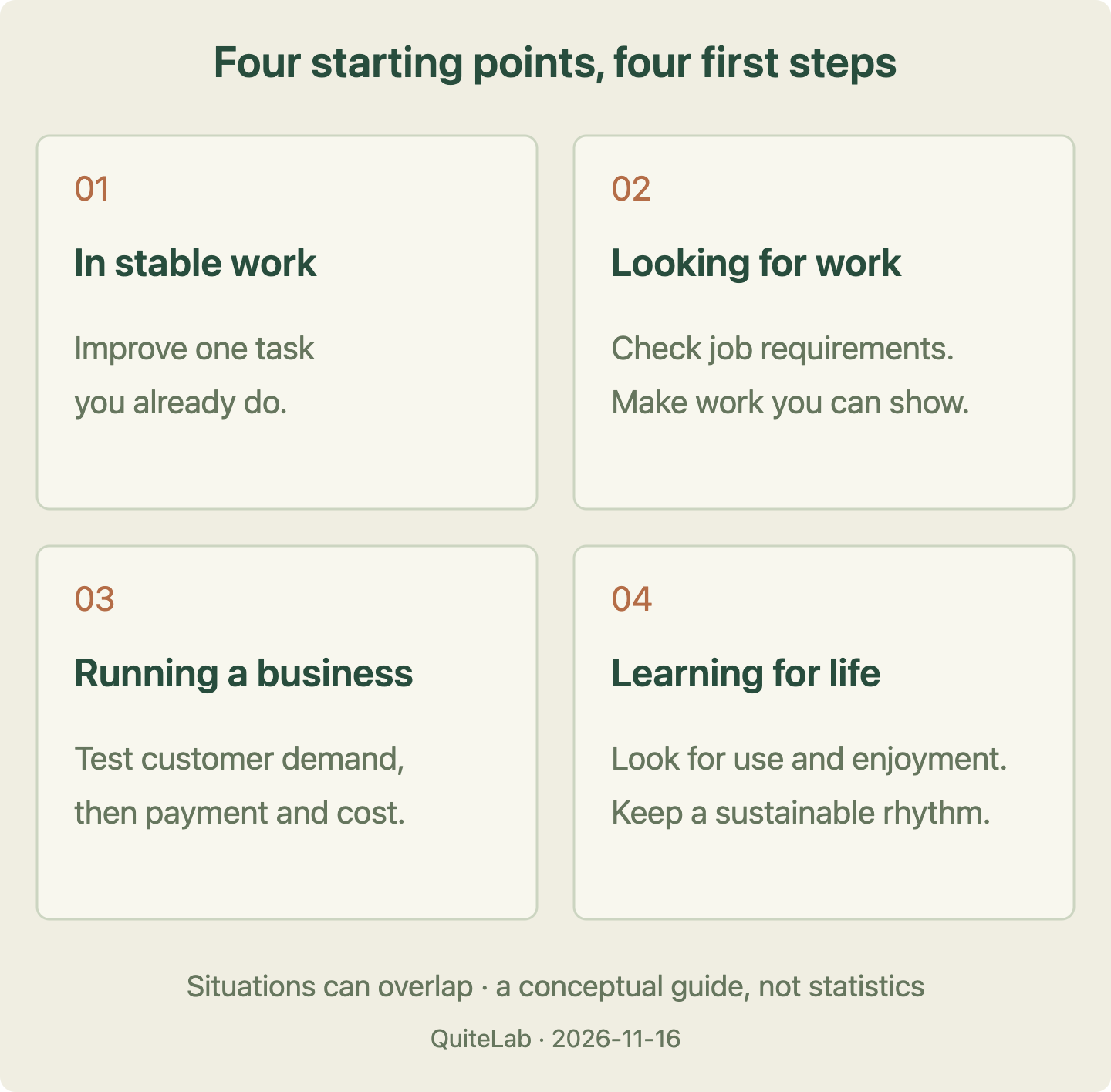
Three real people, three reasons to learn
These examples draw on public reporting, with ages tied to each report. They illustrate different learning paths, not success rates or a promise that the same training will produce the same result.
Chen Bo: Identify a role, then fill the skills gap
When Economic Daily reported on Chen Bo in April 2026, he was 43 and had been a production operator at a lithium-materials company in Yichang. After seeing a recruitment notice, he took welding training at Yidu’s employment training centre, passed an assessment and obtained a special-operation permit. He then secured a mechanical-maintenance role. The report mentioned a pay rise but gave no amount. The useful lesson is the sequence: check an actual job requirement, then develop the matching skill.[5]
This was a move linked to a real vacancy, not evidence that welding training guarantees higher pay. Training costs, duration and longer-term outcomes were not disclosed.
Chang Tingting: Returning to work also needs support and a route into a job
Chang Tingting was 42 when CCTV reported on her in March 2026. She had gained a care-related skills certificate and was working in home-based elder care. A later Ningxia Daily report explained that, after years focused on childcare, she had qualified for funded training and received a public-service job referral. Her route involved more than learning a skill: funding and job matching mattered too. Anyone considering a similar path should check what support is actually available to them.[6][7]
The useful lesson includes how training support and job matching were accessed, as well as which skill was learned. Funded training and referrals depend on local eligibility; the same support cannot be assumed for everyone.
Qiu Zaipeng: Learning for life: begin with something you enjoy making
In a July 2024 China Youth Daily interview, primary-school teacher Qiu Zaipeng, then 45, described joining a paper-cutting taster class in Nanning. After ninety minutes of practice, she had made and mounted a butterfly of her own design. What she valued was space to relax outside work. This was not a career or earnings story. It illustrates another valid purpose for learning: make something you enjoy, then decide how much time you want to give it.[8]
A successful taster session is not a professional qualification. The report did not establish that she earned money from paper-cutting, and the article makes no such claim.
Count the time as well as the fees
Before enrolling, work out the full cost: courses, software, equipment, travel and exams, plus practice time, work you may turn down and household tasks someone else may need to cover. Allow room for practice and feedback between finishing a course and being able to deliver independently. How long that takes depends on the starting point and the task.
Try a sustainable rhythm first—for example, three forty-minute sessions a week for four weeks. This is only a scheduling example, to adapt around shifts, care responsibilities and health. Put the time in the calendar to see whether it actually fits, and discuss the arrangement with your family.
Someone in stable work can first look for chances to practise within existing tasks. A job seeker can check vacancies and cash reserves before putting all hopes in a completion certificate. A business owner can try a small order. Someone learning for personal reasons can use continued participation and the desire to return as feedback.
Use ninety days to test a small path
The plan below is for a low-cost learning experiment, not a promise of completing a career change within a deadline. The aim is to gather information early enough to decide whether the next commitment of time and money is worthwhile.
| Timing | What to do first | What evidence to keep |
|---|---|---|
| Days 1–30 | Choose one purpose and check job, customer or personal needs. Complete a small task using free material or a short trial. | A piece of work you can show, plus the time and money actually spent. |
| Days 31–60 | Get feedback from real users. For employment, check job fit; for business, test use and willingness to pay; for personal learning, check continued use. | Specific changes requested, actual use or a small trial order, beyond positive reactions alone. |
| Days 61–90 | Repeat the task and assess quality, cost and pace. Use the evidence to continue, change purpose, reduce the commitment or pause. | The difference between the first and second delivery, and a clear plan for the next stage. |
For a work-related goal, make the feedback specific. Is a skill being recognised, or is a friend simply being kind? Is rejection about the quality of the work, entry requirements, or a shortage of local jobs? One unsuccessful attempt need not be overinterpreted. Repeated lack of real use is a reason to revisit the need you chose to address.
A certificate’s value depends on whether employers recognise it, whether it is actually required and whether it helps demonstrate capability. Knowledge gained in a course still needs separate testing in the market. Employment also depends on the number of jobs, hiring preferences and local conditions; the outcome cannot all be attributed to individual effort.
Knowing when to adjust is a skill too
Before starting, write down a spending and time limit, a review date and the results you hope to see. If the material is unrelated to the target task and produces nothing you can assess, pause further purchases. If learning persistently squeezes sleep, care or basic living needs, narrow the scope or postpone it.
Money already spent is not sufficient reason to keep spending. You can retain what is useful, bring a method back to your existing work, or recognise that a skill is better suited to a hobby. An experiment can also be valuable because it helps rule out an overly costly path in time.
At forty, learning can still be deep and sustained. Choosing a path that fits real life, practising seriously and paying equal attention to feedback can make it easier to understand why the next step is worth taking.
Where would you put your next stretch of time?
- What have you learned in the past that is still useful today? What made it stay with you?
- What most gets in the way of learning now: time, money, uncertainty about direction, or a lack of practice and feedback?
- If you gave yourself ninety days, would you try a work-related capability or something you simply enjoy?
Experiences and practical approaches are welcome. There is no need to disclose income, an employer, an address or contact details.
How to read the evidence
Sources were checked through 16 November 2026. The research provides background on adult learning; the decision process, exercises and ninety-day plan are this article’s suggestions. Both figures are original conceptual illustrations, not statistical rankings or predictions of training income.
The OECD material uses adult skills surveys and other data from participating countries and economies; it is not presented as statistics for forty-year-olds in China. The ILO examines skills and learning systems across countries, ages and programmes. The World Bank analysis is set in China’s low-carbon transition, rather than evidence of returns in every industry or a particular course.
Sources & reading notes
Research findings, reported personal experiences and the article’s suggestions are distinguished in the text. The diagrams illustrate choices, not statistics. Individual experiences do not establish a success rate or guarantee a training outcome.
- OECD Employment Outlook 2025, Chapter 4: Skills and jobs of older workers ↗2025-07-09
- OECD Education at a Glance 2026: Adult participation in education and training ↗2026-09-29
- ILO: Lifelong Learning and Skills for the Future ↗2026-05-05
- World Bank: Rebalancing Growth, China Economic Update — release ↗2026-07-07
- Economic Daily: Employment grows with industry (republished by the human-resources ministry) ↗2026-04-03
- CCTV Focus Report: Skills training and work (full transcript republished by Red Star News) ↗2026-03-26
- Ningxia Daily: Building employment security for urban workers ↗2026-05-12
- China Youth Daily: Survey respondents’ interest in evening classes ↗2024-07-26
A question for the table
What have you learned that is still useful today? Given ninety days, what capability—or something you simply enjoy—would you try? Specific experiences are welcome, without personal financial or contact details.